
5. Damage Assessment
The Damage Assessment pipeline analyzes your inspection photos to identify, classify, and document property damage, then generates a fully-costed repair scope. The AI works through six sequential steps, from raw image analysis through to validated line items with quantities and pricing.
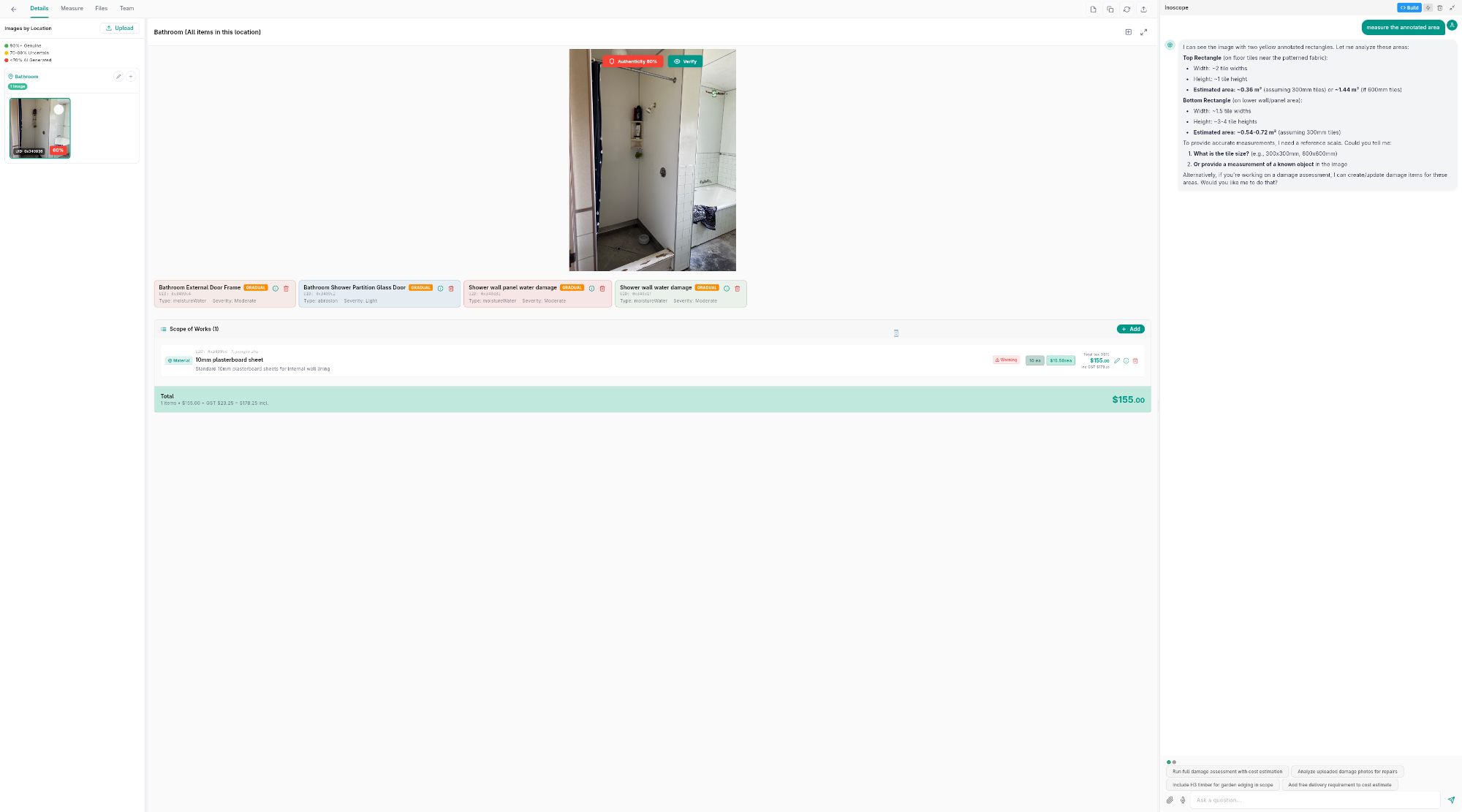
Assessment Layout
Damage Assessments use a three-panel layout:
- Left panel — Image thumbnails organized by location group (persistent across all tabs)
- Center panel — Main workspace with four tabs
- Right panel — AI Chat assistant
| Tab | Contents |
|---|---|
| Details | Uploaded images with damage bounding boxes, detected damage item cards (color-coded by severity), and Scope of Works line items |
| Measure | Drawing tools overlaid on the selected photo for annotating dimensions |
| Files | All uploaded images and documents |
| Team | Team members and access roles |
Running the Pipeline
The pipeline processes all uploaded images automatically, end-to-end, without interruption. It is the fastest way to go from photos to a fully-costed repair scope. Use the Chat Agent to refine results, ask questions, or add items after the pipeline has run. For a full comparison, see Pipeline vs Chat.
- Open a Damage Assessment with uploaded images.
- Click the Run button.
- The prompt dialog appears:
- Optionally enter a custom prompt to guide the AI (e.g., "Focus on water damage in the ceiling area").
- Leave the prompt empty to run general damage detection across all images.
- Click Run to start.
- A processing indicator shows real-time progress as each pipeline step completes.
The pipeline runs across all images in the assessment. Each image is analyzed individually, and results are consolidated into a single set of damage items and line items.
The 6-Step Pipeline
| Step | Name | What Happens |
|---|---|---|
| 1 | Analyze Damage | Classifies all damage visible in images — sets damage type, bounding boxes (as percentage coordinates), severity, and description for each damage area |
| 2 | Generate Repair Scope | Creates repair line items (materials, labour, equipment) based on the damage analysis — no costs at this stage |
| 3 | Estimate Quantities | Resolves quantities for every line item: first checks documents, then drawings, then uses an engineering estimate — no item is left with quantity zero |
| 4 | Estimate Costs | Prices each item in mandatory order: Materials and Equipment first, then Other Costs (overhead, site services), then Labour last — every cost is sourced from a search result with an explanation |
| 5 | Calculate Totals | Computes group subtotals and the overall assessment total, then reports a final summary |
| 6 | Validate and Auto-Fix | Checks for unsplit groups, unpriced items, missing damage item references, and missing quantities — reruns the relevant step automatically if errors are found (single retry) |
Damage Items
For each detected damage area, the AI creates a damage item containing:
| Field | Description |
|---|---|
| Damage Type | Classification of the damage (see table below) |
| Damage Cause | How the damage occurred (Accidental, Wear and Tear, Gradual, Maintenance) |
| Severity | How serious the damage is (see severity table below) |
| Bounding Box | Rectangle on the image marking the exact damage location, expressed as [xmin, ymin, xmax, ymax] percentages of the image dimensions |
| Confidence Score | How certain the AI is about the detection (0–100%) |
| Policy Payout Type | Sudden (typically covered) or Gradual (may not be covered) — used in insurance assessments |
| Materials Affected | What materials are damaged |
| Fix Method | Recommended repair approach |
| Fix Area | Estimated area requiring repair (m²) |
Damage Types
| Type | Description |
|---|---|
| Abrasion | Surface scratching, scuffing, or wearing |
| Impact | Damage from physical force (dents, cracks, breaks) |
| Expansion/Contraction | Cracking or warping from temperature or moisture changes |
| Moisture/Water | Water stains, mold, rot, swelling |
| Temperature | Heat or cold damage (blistering, frost damage) |
| Chemical | Corrosion, discoloration, or degradation from chemicals |
| Fire | Burn marks, smoke damage, charring |
Severity Levels
| Severity | Meaning |
|---|---|
| Low | Minor damage, cosmetic or non-urgent |
| Medium | Moderate damage requiring attention |
| High | Significant damage needing prompt repair |
| Critical | Severe damage requiring immediate action |
Severity is shown with color coding on the damage item cards and on the bounding boxes drawn over the images.
Reviewing Damage Items
After the pipeline completes, switch to the Details tab to review results:
- Each damage item appears as a card showing damage type, severity (color-coded), affected materials, fix method, fix area, confidence score, and the linked image with its bounding box.
- Click a damage item to highlight its bounding box on the image.
- The Scope of Works section below the damage items shows the generated line items with quantities and costs.
Editing Damage Items
You can modify any detected damage item to correct or refine the AI's output:
- Click on a damage item to select it.
- Open the edit dialog.
- Adjust any field:
| Field | Description |
|---|---|
| Type | Change the damage type |
| Cause | Change the damage cause |
| Severity | Adjust the severity level |
| Materials Affected | Specify what materials are damaged |
| Fix Method | Describe how the damage should be repaired |
| Fix Area | Enter the area in square meters that needs repair |
| Location | Update the location description |
- Click Save to update the damage item.
Adding Damage Items Manually
If the AI missed something, you can add damage items by hand:
- On the Details tab, click Add Damage Item.
- Fill in the damage item fields (type, cause, severity, etc.).
- Optionally draw a bounding box on the image to mark the location.
- Click Save.
To remove a false positive, select the damage item, click Delete, and confirm. The damage item and its bounding box are removed.
Insurance Claim Context (Inoclaim)
When a Damage Assessment is run within an Inoclaim insurance assessment, steps 3 and 4 (Estimate Quantities and Estimate Costs) automatically apply additional insurance-specific rules:
| Rule Area | Description |
|---|---|
| Full element measurement | The entire element is measured, not just the damaged area |
| Property age | Age of the property and affected elements is factored in |
| 4-tier material identification | Materials are matched in order: exactly the same → almost the same → suitable replacement → like for like |
| Policy priority | Excess, limits, and betterment provisions are applied from the insurance policy |
| Replace vs repair analysis | Economic comparison to determine whether replacement or repair is more appropriate |
| Occupied property adjustments | Additional costs for working in an occupied property are included |
| P&G, travel, and return visits | Preliminaries, general conditions, travel costs, and return visit costs are included |
| Difficulty and access adjustments | Costs for difficult access or unusual site conditions are applied |
| By-law trigger costs | Where repairs trigger compliance requirements, by-law costs are included |
These rules are loaded automatically — no additional configuration is required when working in Inoclaim.
Tips for Better Detection
- Good lighting: Well-lit photos produce better detection results.
- Multiple angles: Photograph damage from different angles to capture its full extent.
- Close-ups: Include close-up shots of damage areas for detailed analysis.
- Context shots: Include wider shots showing the damage in its surroundings.
- Custom prompts: Use specific prompts like "Focus on water damage on the ceiling" to direct the AI. You can also use the chat agent for follow-up analysis after the pipeline has run.