General Assessment
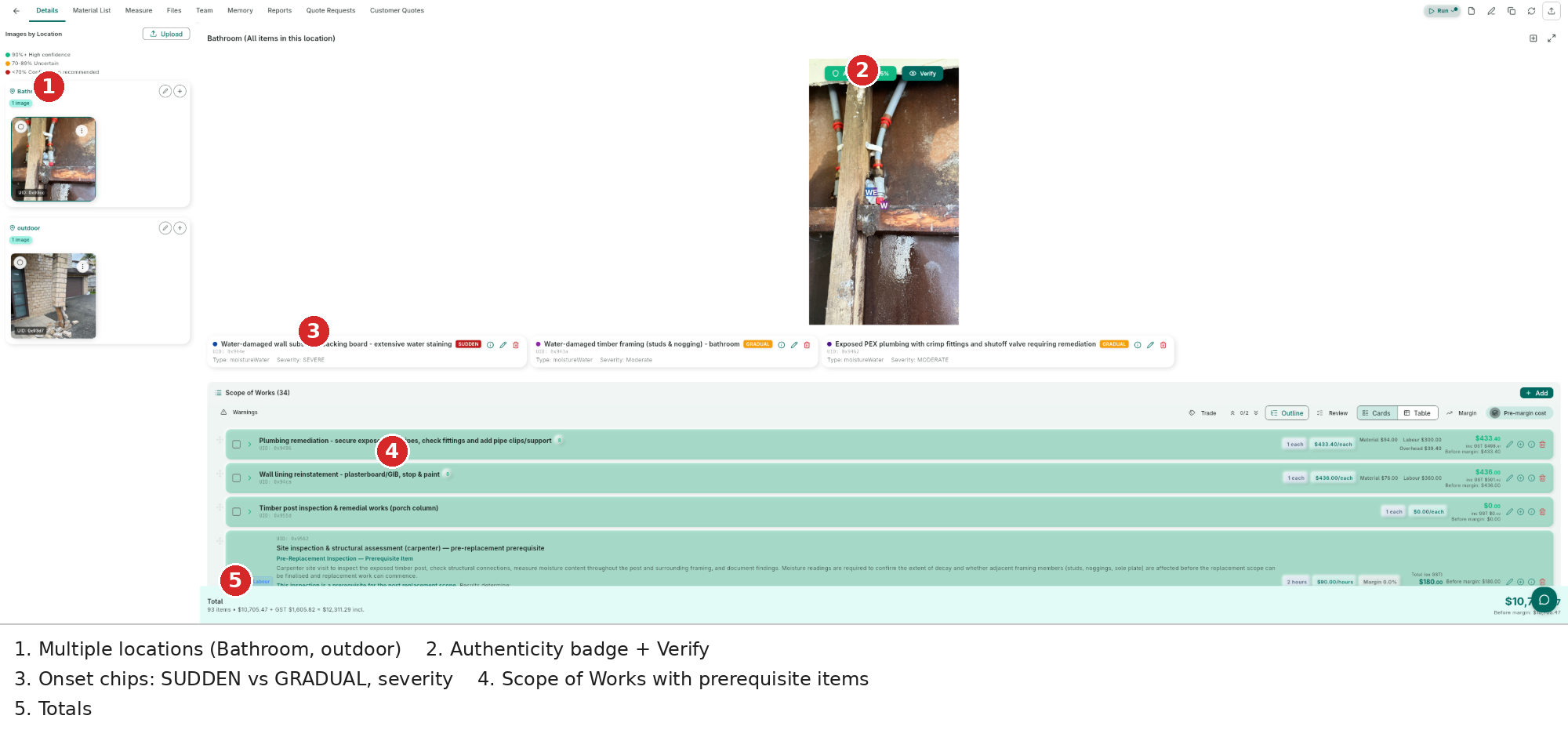
The General Work Assessment pipeline analyzes your inspection photos to scope maintenance, renovation, and repair work. Unlike the Damage Assessment, it does not produce damage items — it goes directly from image analysis to a costed work scope with line items for materials, labour, and equipment.

Assessment Layout
General Work Assessments share the same three-panel layout as Damage Assessments:
- Left panel — Image thumbnails organized by location group
- Center panel — Main workspace with four tabs
- Right panel — AI Chat assistant
| Tab | Contents |
|---|---|
| Details | Uploaded images, Scope of Works line items with quantities and costs |
| Measure | Drawing tools overlaid on photos for annotating dimensions |
| Files | All uploaded images and documents |
| Team | Team members and access roles |
The key difference from Damage Assessment: the Details tab shows Scope of Works items directly — there is no damage items section.
Running the Pipeline
The pipeline processes all uploaded images automatically, end-to-end, without interruption. It is the fastest way to go from photos to a costed work scope. Use the Chat Agent to refine results, ask questions, or add items after the pipeline has run. For a full comparison, see Pipeline vs Chat.
- Open a General Work Assessment with uploaded images.
- Click the Run button.
- The prompt dialog appears:
- Optionally enter a custom prompt to focus the AI on specific work (e.g., "Scope the bathroom retiling and vanity replacement").
- Leave the prompt empty to generate a general work scope from all uploaded images.
- Click Run to start.
- A processing indicator shows real-time progress as each pipeline step completes.
The pipeline runs across all images and any uploaded documents. Each image is analyzed to understand what work is required, and the results are consolidated into a single set of line items.
The 5-Step Pipeline
| Step | Name | What Happens |
|---|---|---|
| 1 | Create Work Scope | Analyzes all images and documents, then creates line items for the required work — materials, labour, and equipment with quantities. No costs at this stage. |
| 2 | Estimate Quantities | Resolves quantities for every line item: first checks documents, then drawings, then uses an engineering estimate — no item is left with quantity zero |
| 3 | Estimate Costs | Prices each item in mandatory order: Materials and Equipment first, then Other Costs (overhead, site services), then Labour last — every cost is sourced from a search result with an explanation |
| 4 | Calculate Totals | Computes group subtotals and the overall assessment total, then reports a final summary |
| 5 | Validate and Auto-Fix | Checks for unsplit groups, unpriced items, and missing quantities — reruns the relevant step automatically if errors are found (single retry) |
What the AI Produces
The pipeline produces a hierarchical set of work scope line items grouped by trade or work area. Each leaf item is one of three types:
| Item Type | Description |
|---|---|
| Material | A physical product or supply required for the work |
| Labour | A trade or labour activity required to complete the work |
| Equipment | Plant, tools, or hired equipment required on site |
GROUP items act as parent containers. The AI creates GROUP parents automatically — they are not individually priced; their totals roll up from their children.
For a full reference on line item types, the hierarchy, editing fields, and cost estimation, see Line Items and Costing.
Reviewing and Editing Line Items
After the pipeline completes, the Details tab shows the generated line items with quantities, unit rates, and totals.
- Review each group and its children to confirm the scope is complete and accurate.
- Click any line item to open the edit dialog and adjust description, quantity, unit, or cost.
- Add missing items using the Add Line Item button within any group.
- Delete items that do not apply using the item's menu.
For full editing instructions, see Line Items and Costing.
Tips for Better Results
- Good lighting: Well-lit photos allow the AI to read surface conditions, material types, and extent of work accurately.
- Coverage: Photograph every area that needs work, including contextual shots to show scale and access conditions.
- Multiple angles: Capture the same area from different angles to help the AI estimate quantities more accurately.
- Specific prompts: The more specific your prompt, the more targeted the scope. For example, "Scope the roof repairs including ridge capping and flashing" produces a more precise output than a blank prompt.
- Documents: Upload any existing scope notes, plans, or specifications along with the photos — the AI incorporates them during quantity estimation.
- Follow-up with chat: After the pipeline has run, use the chat agent to ask follow-up questions, request additional items, or refine quantities interactively.